When a massive late-summer heatwave triggers rolling blackouts, public attention focuses immediately on air conditioning and grid reliability. But under the city streets, a far more insidious infrastructure failure is taking place: the loss of municipal water pressure.
If your building’s water suddenly stops flowing in August, the standard psychological reflex is to open the faucet handles and leave them open, waiting to hear the familiar hiss and splutter of returning water.
This is a dangerous plumbing mistake.
Leaving your faucets open during a municipal supply failure converts your apartment’s internal plumbing loop into an accidental vacuum pump. Through a fluid dynamics phenomenon known as backsiphonage, you risk pulling contaminated greywater, stagnant drain liquids, or wastewater from neighboring fixtures straight backward into your primary drinking lines.
To secure your water supply during an infrastructure collapse, you must treat your plumbing as a closed, tactical envelope. Here is the physics behind plumbing inversion and how to execute hydraulic isolation.
The Physics of Backsiphonage
Municipal water networks rely on massive electrical pumps to maintain a constant positive pressure, typically between 40 to 60 Pounds per Square Inch (PSI). This positive pressure acts as a one-way wall, forcing water out of your taps and preventing anything from entering the pipes from the outside.
When power fails or water mains burst, that positive pressure drops to zero. As water drains out of the lowest points of the city’s pipe grid via gravity, it creates a powerful localized vacuum inside the empty lines.
According to Torricelli’s Law and basic atmospheric pressure mechanics, this drop creates a negative pressure state inside the vertical plumbing stacks of multi-story buildings. If a faucet, showerhead, or valve is left open at a high point in the building, the pipe network functions exactly like a drinking straw. It will pull air, or any available liquid, from low points to fill the void.
The Cross-Connection Danger
This negative pressure becomes toxic when it encounters a cross-connection, any point where potable (drinking) water lines physically interface with non-potable water systems.
Consider a historical plumbing diagram illustrating a shared line between a water closet (toilet) and a drinking fountain.
If a vacuum forms in the main riser while the water closet valve is compromised or open, the atmospheric pressure pushing down on the fluid in the toilet bowl will force that contaminated liquid backward into the distribution pipe, flowing directly toward the drinking fountain or any neighboring outlet.
In a modern apartment, common everyday cross-connections include:
- A hand-held showerhead submerged in a filled bathtub.
- A garden hose left sitting inside a bucket of utility water on a balcony.
- The internal fill valves of standard toilet tanks.
- The intake lines of washing machines or dishwashers.
If you crack open your kitchen tap to “test the line” during a major municipal pressure drop, the suction can draw dirty water from these cross-connections directly into your apartment’s internal lines. When city pressure eventually restores, that stagnant, contaminated water is pushed straight out of your kitchen tap.
The Protocol: Hydraulic Envelope Isolation
To protect your immediate environment from municipal backsiphonage, you must decouple your apartment from the city network the moment you detect a drop in flow pressure.
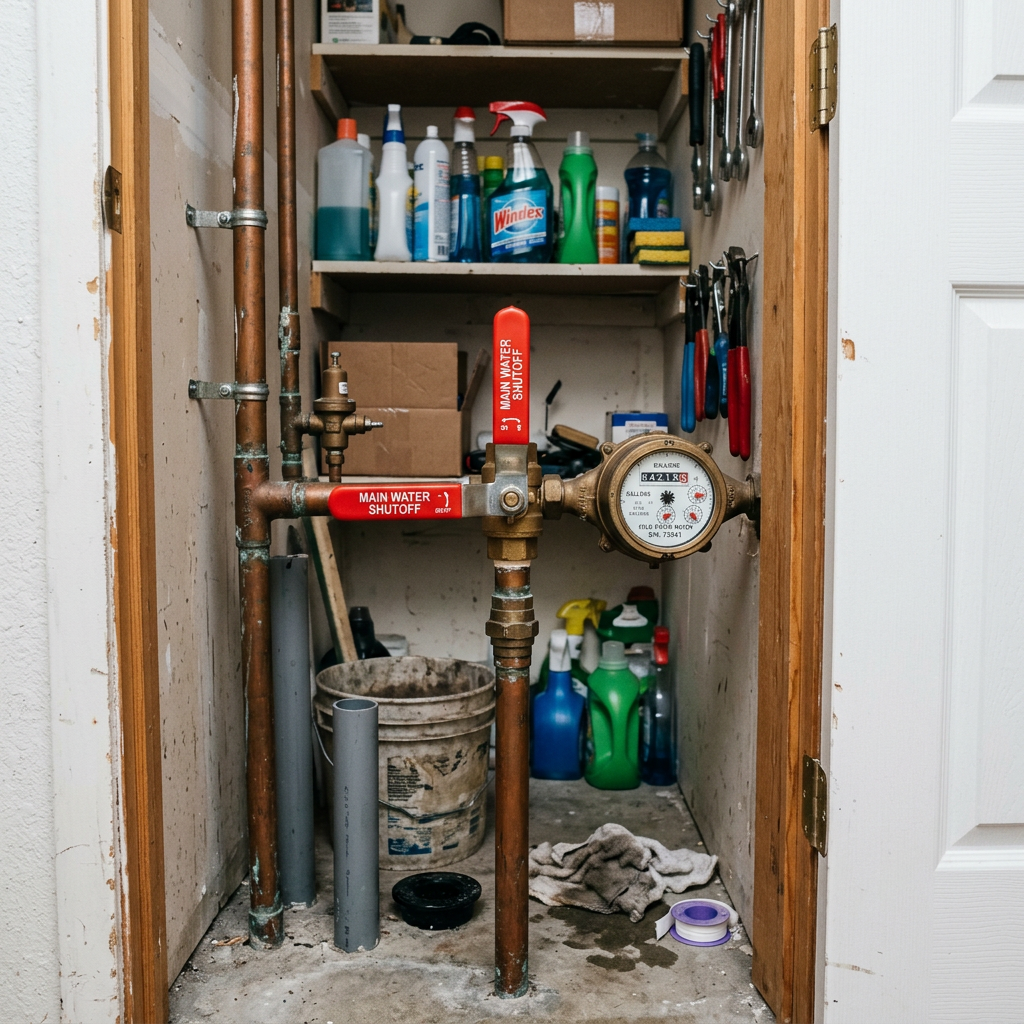
1.Shut Down the Main Envelope Valve (Immediate Response)
Locate your unit’s main internal water shutoff valve. In apartments, this is typically found behind a small access panel near the water heater, under the kitchen sink, or near the main bathroom stack. Turn the valve fully clockwise to seal your internal plumbing away from the compromised city grid.
2.Break the Internal Vacuum (Atmospheric Stabilization)
Go to the physically highest water fixture in your apartment (usually the showerhead or bathroom sink). Open the hot and cold valves completely. This allows ambient air to enter the top of your internal system, breaking any localized siphon loops and safely dropping the remaining water down to your lower fixtures.
3.Drain the Static Line Reservoir (The Gravity Harvest)
Go to the physically lowest fixture in your apartment (usually a bathtub tap or kitchen faucet). Place clean storage containers underneath it and crack the valve open. The clean, treated water sitting inside your vertical wall pipes will flow out via pure gravity, driven by the atmospheric air entering from the upper fixture you opened in Step 2.
4.Isolate the Water Heater Tank (Accessing the Secondary Buffer)
Your apartment contains a massive hidden water cache: your standard water heater. For a typical unit, this holds 30 to 50 gallons of perfectly clean, pre-filtered water. Shut off the electrical breaker to the water heater first to prevent element burnout. Connect a hose or place a bucket under the drain valve at the base of the tank, open the temperature-pressure relief valve at the top to allow air intake, and drain clean water as needed.
Emergency Fluid Allocation
Once your plumbing loop is isolated, the water remaining inside your apartment’s boundaries must be triaged aggressively based on purity layers:
| Water Resource | Purity State | Primary Safety Function |
| Pipes & Water Heater Tank | Potable (Clean) | Drinking, metabolic hydration, essential medical use. |
| Toilet Tank Reservoirs | Clean Utility | Hand washing, basic surface decontamination (Note: The tank water is clean; the bowl water is biohazardous). |
| Stored Greywater / Sump | Non-Potable (Dirty) | Reserved strictly for dry-sanitation cover priming. |
The Separation Golden Rule: Never mix your water reservoirs. Once a gallon of water leaves your isolated water heater tank, it must never enter a container that has held unboiled or unmanaged municipal water.
By understanding the fluid dynamics of negative pressure, you convert a broad urban utility failure into a localized, manageable equation. You keep the city’s contaminants out of your walls and secure a multi-day emergency reservoir using the assets you already own.
In our next article, we will look at utilizing gravity to treat external water inputs safely when your internal reservoirs dry up, breaking down the mechanics of The Static Filter.
Leave a Reply