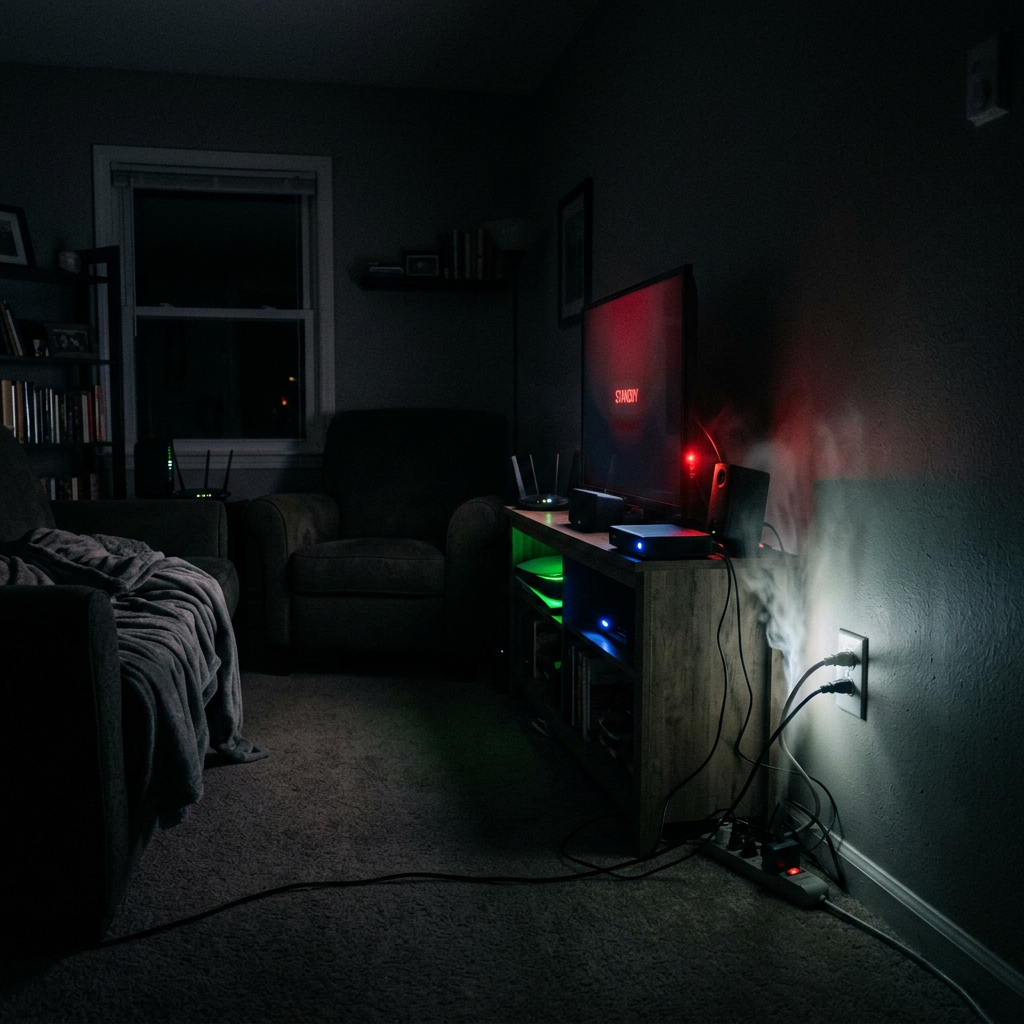
When a severe weather event knocks out a regional substation or utility companies spike peak-hour electricity rates, the standard consumer response is defense. People run around shutting off lights, dialing back the thermostat, and preparing to sit in the dark.
This is a reactive, surface-level strategy.
The harsh reality of modern residential engineering is that your apartment is bleeding power every single second of the day, even when you think everything is turned completely off. You are not paying strictly for the energy you actively use; you are paying a massive structural premium for what you leave sleeping.
This hidden drain is known as Standby Power, Vampire Draw, or a Phantom Load. In the average modern home, these microscopic, parasitic power leaks run a continuous, baseline energy drain that accounts for up to 10% of your monthly utility bill.
If you want to achieve genuine energy resilience, you cannot just focus on generation or rationing. You must treat your living space as a tight, closed electrical envelope. Here is the engineering behind phantom loads and how to systematically locate and eliminate the electrical leaks in your walls.
The Physics of the Vampire Draw
To understand why a device draws power when it is turned “off,” we have to look at the internal architecture of modern electronics.
Older appliances used physical, mechanical toggle switches. When you flipped the switch, it physically severed the copper wire connecting the device to the incoming wall current. The circuit was open; current flow dropped to absolute zero.
Modern electronics do not use physical switches. Instead, they rely on Switched-Mode Power Supplies (SMPS) and solid-state logic boards. When you press the power button on your television, microwave, audio receiver, or smart appliance, you are not cutting the power. You are simply sending a low-voltage signal to a microprocessor telling the device to enter a low-power state.
[Wall Outlet: 110V/220V AC] │ ▼┌───────────────────────┐│ Internal Transformer │ ◄── ALWAYS ENERGIZED (Generates Heat / Core Loss)└───────────┬───────────┘ │ Low-Voltage DC ▼┌───────────────────────┐│ Microprocessor / Logic│ ◄── ALWAYS LISTENING (Waiting for Remote or Wake-Word)└───────────────────────┘
The device remains permanently energized for three technical reasons:
- Continuous Signal Monitoring: The internal logic board must stay awake to listen for an infrared signal from a remote control, an incoming network packet over Wi-Fi, or an audio wake-word from a microphone.
- Transformer Inefficiency: The small power adapters (the “wall warts” or brick chargers) that step down high-voltage AC wall current to low-voltage DC current contain small internal transformers. As long as that brick is plugged into the wall, the primary copper coil is energized, continuously generating a small magnetic field that dissipates into the room as invisible core loss heat, even if no device is connected to the other end.
- Volatile Memory Maintenance: Internal clocks, settings, and status LEDs require a constant trickle of direct current to prevent the device from resetting its state.
The Apparent Power Equation
Individually, these phantom loads seem negligible, a smart speaker draws roughly 2W on standby; a desktop computer setup can leak 10W to 15W; an old microwave clock might pull 5W.
But electrical bills are cumulative. Because these devices are plugged in 24 hours a day, 365 days a year, their baseline power consumption runs constantly in the background.
To audit your home, you must measure Apparent Power (S), which is the total power circulating in an AC circuit, calculated as the product of root-mean-square (RMS) voltage (V) and RMS current (I): S = V x I
Where S is expressed in Volt-Amperes (VA), which for simple residential loads closely tracks with real power measured in Watts (W).
If your apartment has a continuous, unmonitored phantom baseload of just 100W, an incredibly common baseline for an apartment with a TV, router, a few smart chargers, and kitchen appliances, your cumulative energy drain over a single month is easily calculated:
100W x 24 hours/day x 30 days = 72,000Wh = 72kWh
In many urban zones, 72kWh of pure waste power can translate to hundreds of dollars a year stripped straight out of your pocket for utility overhead you never actively enjoyed.
The Protocol: Executing the Baseload Audit
To reclaim this energy and lower your baseline before deploying off-grid battery systems, you must perform a mechanical baseline audit.
1.Establish Your Baseline:Day 1 – Evening.
Locate your apartment’s smart utility meter or use an inline whole-house monitor. Turn off every active appliance, light, and climate control system. Look at the real-time consumption readout on the meter. Whatever number you see remaining, whether it is 80W or 250W, is your baseline phantom load.
2.Deploy the Wattmeter:The Appliance Audit.
Procure a simple, digital plug-in wattmeter (often called a Kill-A-Watt meter). Unplug a target appliance, insert the wattmeter into the wall outlet, and plug the appliance into the meter. Turn the appliance “off” via its standard button and read the standby wattage display.
3.Triage the Offenders:Categorization.
Log your findings systematically. Target the highest-vampire offenders first: entertainment centers (TVs, soundbars, game consoles), home office hubs (monitors, desktop towers, printers), and small kitchen appliances with digital displays (coffee makers, microwaves).
4.Install Zero-Leakage Breaks:The Elimination Step.
For devices that must remain grouped together (like a computer workstation or an entertainment system), deploy heavy-duty power strips equipped with true mechanical on/off toggle switches. When you flip that physical switch at the end of the day, you are physically breaking the copper line, dropping the standby current to absolute zero.
5.Automate the Cutoff:Smart Strips.
For hard-to-reach outlets, use master-controlled smart strips. These strips feature a designated “master” outlet (e.g., for your computer tower). When the master outlet detects a drop in current draw (because you shut down your PC), it automatically severs power to all peripheral secondary outlets (monitors, speakers, printers), purging the entire network’s phantom load instantly.
Phantom Offense Profiles
When auditing your home, prioritize your interventions based on the typical standby consumption profiles of common residential electronics:
| Appliance Class | Hidden Subsystem Active | Avg. Standby Power | Strategic Intervention |
| Home Wi-Fi Router / Modem | Continuous RF transmission & routing logic | 7W – 12W | Keep active, but route to an isolated, dedicated low-wattage line. |
| Smart TV & Soundbar | Instant-on IR receiver / Wi-Fi standby state | 6W – 15W | Mechanical switch power strip; cut completely when not in use. |
| Desktop PC Setup (Idle) | RAM suspend-to-state / motherboard logic | 10W – 25W | Master-controlled power strip deployment. |
| Microwave / Kitchen Tech | Continuous vacuum fluorescent display (VFD) clock | 3W – 8W | Unplug directly or install an inline mechanical outlet switch. |
| Unloaded Phone/Laptop Bricks | Internal transformer core losses (Magnetization) | 0.5W – 2W | Strict “no-device, no-plug” discipline. |
The Transformer Trap: If a charger brick feels warm to the touch even when it isn’t connected to a device, it is actively wasting energy via core losses. It is acting as a tiny, highly inefficient space heater inside your wall. Unplug it immediately.
By systematically hunting down and executing your home’s phantom loads, you shrink your daily electrical baseline. This not only saves immediate capital on your monthly utility bill, but it drastically reduces the physical size, and cost of the backup battery banks and solar setups you need to survive an actual grid-down crisis.
In our next piece, we will look at how to efficiently charge your devices once your baseline is cleared, bypassing the inherent thermodynamic waste of alternating current in The DC-Direct Revolution.
Leave a Reply