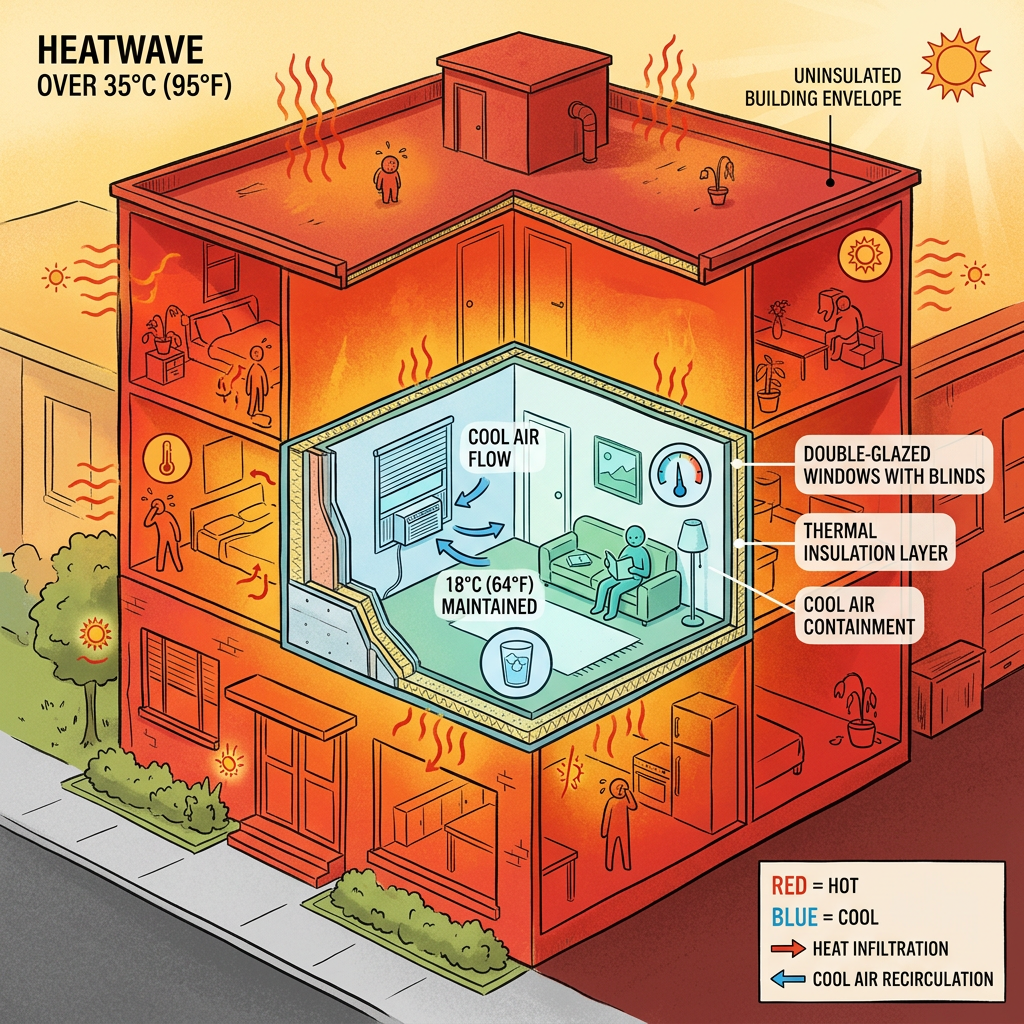
The most dangerous scenario in a modern urban environment is not just a heatwave, but a coincident peak failure: when the electrical grid collapses under the cooling demand. In a blackout, your fans stop. Your “Pressure Hack” airflows slow down. Your apartment begins to equilibrate with the massive thermal inertia of the building’s concrete shell.
To survive this, you must stop viewing your apartment as a collection of rooms and start viewing it as a thermodynamic battery. If you cannot move heat out of the building with electricity, you must move it into a passive heat sink.
The most effective, readily available material for this is right in your pipes: water.
The Physics of Thermal Inertia
Every material has a Specific Heat Capacity (cp) — the amount of heat energy required to raise the temperature of one gram of the substance by one degree Celsius.
Compare these three common urban materials:
| Material | Specific Heat Capacity (J/g∘C) | Function in a Heatwave |
| Air | ~1.00 | Transports heat (Low density, poor storage) |
| Concrete/Brick | ~0.80 – 0.90 | The Enemy (Massive volume, stores heat all day) |
| Water | 4.184 | The Buffer (Highest capacity for heat absorption) |
Water has a heat capacity nearly five times higher than the concrete walls surrounding you. This means a relatively small volume of water can absorb a massive amount of “sensible heat” from your living environment without significantly rising in temperature itself.
1. Mapping Your “Core Zone” Sanctuary
In a blackout, you cannot cool the entire apartment. You must identify and defend a Core Zone.
- Internal Geometry: Find the room with the fewest exterior-facing walls (typically a hallway, a walk-in closet, or a windowless bathroom).
- The Concrete Buffer: These internal spaces are shielded from direct solar radiation (Part 2) and are surrounded by the building’s internal thermal mass, which takes much longer to heat up than the exterior skin.
- The Floor Factor: Stay low. Because of thermal stratification, the air temperature at floor level can be 3–5°C cooler than at head height.
2. Deploying the “Water Sponge”
If the grid fails, your tap water is likely still running (driven by gravity tanks or separate municipal pumps). This water is coming from underground pipes and is significantly cooler than the ambient air, often between 15°C and 20°C (60°F–68°F).
The Charging Phase (Early Morning)
Before the sun hits its peak, fill your bathtub, various buckets, and every large container you own with the coldest water possible. Place these containers in your Core Zone.
The Absorption Phase (The Heat Peak)
As the air in your apartment begins to rise toward 35°C (95°F), the water in your containers acts as a thermal sponge. Through convection and radiation, the heat in the air will naturally migrate toward the cooler water.
- The Math of Relief: 50 gallons (approx. 190 liters) of cold tap water can absorb roughly 12,000 BTUs of heat just by rising 10 degrees. That is the equivalent cooling power of a small portable AC unit running for an hour, delivered entirely through passive physics.
The Purge Phase (Night)
Once the sun sets and the outside air temperature finally drops below the temperature of your “sponge” (which will now be lukewarm), drain the water. Do not keep it overnight; if it has reached 28°C or 30°C, it will begin radiating that heat back into your Core Zone. Flush it and, if possible, refill with fresh, cool night-time tap water to reset the sink for the next day.
3. Physiological Heat Sinking (The Cold Core)
In a survival scenario, you aren’t just cooling the room; you are cooling your biological core.
If you are overheating, do not waste water by splashing it on your face. Use the High-Blood-Flow Points. Submerge your feet and ankles, or your forearms and wrists, in the cool water of your “sponge” containers. These areas have high concentrations of blood vessels near the skin’s surface. By cooling the blood in your extremities, you use your own circulatory system as a liquid cooling loop to drop your core temperature.
Summary: The “AC OFF” Hierarchy of Defense
- Pressure: Force air velocity to break the boundary layer.
- Albedo: Reflect radiation before it touches the glass.
- Psychrometrics: Use moisture only when the humidity-to-exhaust ratio is safe.
- Thermal Mass: Buffer the remaining heat into water-based sinks during a blackout.
By mastering these four layers of physics, the “unlivable” urban heatwave becomes a manageable technical challenge. You aren’t just surviving; you are reclaiming the knowledge of self-reliance that modern infrastructure tried to make you forget.
Leave a Reply